
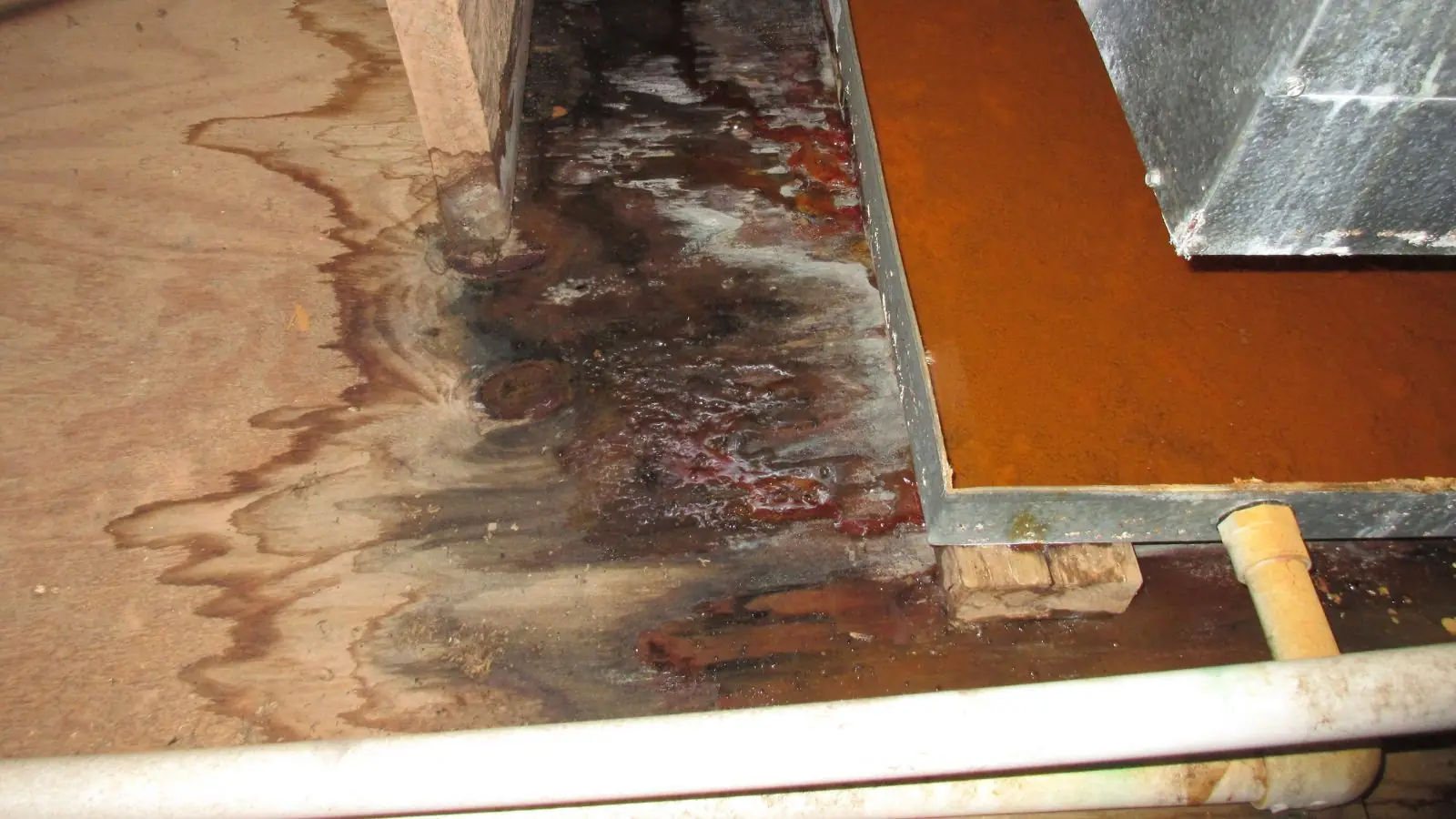
Get the water off the surface, stop the source, and start moving air across the floor right away. Wood absorbs moisture through its edges and underside, so a floor can look fine on top while the planks swell below. EPA guidance says to dry water-damaged areas within 24 to 48 hours to prevent mold, and wood floors are one of the materials where that clock matters most.
Do not wait to see whether the boards bend. Cupping often shows up days later, after the worst chance to stop it has passed.
What the water is doing to the planks
Wood is made of tiny tubes that swell as they fill. The bottom of a plank usually stays wetter than the top, because the underside sits against a subfloor or slab. When the underside swells faster than the face, the edges lift and the board curves.
Cupping
The edges of each board rise higher than the center, so the floor looks like a row of shallow troughs. This is the most common early sign and it can be reversible if the floor dries slowly and evenly.
Crowning
The center rises above the edges. It often appears after a cupped floor is sanded too early, before the boards have finished drying.
Buckling
Boards lift off the subfloor, sometimes in a ridge across the room. This is the severe stage, and the floor may need partial removal to relieve pressure.
Gaps and staining
As boards dry and shrink, gaps open between them. Dark stains at seams can point to trapped moisture or a dirty water source.
The first 48 hours, step by step
Stop the source and get the standing water out
Close the fixture valve or the house shut-off. Mop or use a wet vacuum on puddles, and remove rugs and furniture that hold water against the boards.
Photograph before you move anything
Take wide and close photos of the damage and the source. The California Department of Insurance advises photographs if possible, and your insurer will ask for them.
Start air movement and lower the humidity
Point fans across the floor, not at it, and run the air conditioning to pull moisture from the room. Household fans help only with surface moisture, so bring in trained crews if the floor has been wet more than a few hours.
Get a moisture reading on day one or two
A meter compares the wet floor to a dry reference board. Readings taken each day show whether the floor is drying toward normal or holding water underneath.
If water is under the planks, the floor often needs to be dried from below or through small openings. Crews use injection drying with mats or ports that pull moisture out of the cavity. This equipment needs training to run correctly, so we do not rent it out. If you are comparing options, see how emergency water removal handles the standing-water stage.
Two common scenarios and how they differ
| Scenario | How the water spreads | What to watch |
|---|---|---|
| Air conditioner condensate line overflows or clogs | Slow, often hidden drip from a closet, attic or wall cavity above, wetting the floor edges first | Staining near the unit, damp baseboards and cupping that appears over days rather than hours |
| Washer supply valve or hose fails | Sudden volume of clean water that runs into adjoining rooms and under cabinets | Floor under the laundry area, plus any wood that continues past a doorway |
| Dishwasher or sink supply leaks | Water pools under cabinets and spreads along the toe kick | Soft cabinet bases, odor, and boards near the kitchen island |
| Rain or outside water through a door | Water enters at one point and spreads along low spots | Grit, mud and dirty water, which changes the cleanup plan |
A condensate line leak is slow and easy to miss. A washer valve failure is fast and obvious. Both can end with cupped boards.
Wood floor wet right now?
Call (949) 670-0939 and ask for same-day response when available. The 24/7 line is open for active leaks.
Do and do not, while you wait
On a wet wood floor
- Do remove wet rugs, mats and boxes, and wipe the surface dry.
- Do keep foot traffic off swollen boards, since they can split and snap.
- Do not use a heat gun, hair dryer or space heater to speed things up. Fast drying cracks and warps boards.
- Do not seal, wax or refinish until the floor reads dry across several days.
- Do not drill holes in the floor yourself. Injection ports are placed on a plan.
- Stay out if water reached outlets or a panel, or if sewage is involved, and call 911 or your utility first.
Wet wood floors in Laguna Niguel: rain season and slab homes
NOAA's 1991 to 2020 normals for the Laguna Beach station show most rain falling from November through March, with January near 2.8 inches and February near 3.4. Those are the months when roof leaks, door thresholds and window sills deliver water to floors. Check your seals in early fall and keep rugs back from exterior doors in winter.
Many Laguna Niguel homes sit on a concrete slab or a raised foundation rather than a basement. A wood floor over a slab can wick moisture from below as well as above, and a raised floor can trap it in the crawl space. Ask your inspector which type you have, because it changes where the crew needs to look.
Your water comes from Moulton Niguel Water District. If you hear water running with every fixture off, the meter will show it, and the district has a 24/7 emergency line for main-line trouble.
Nearby, Mission Viejo and Dana Point have many homes with similar floor types, so the same early steps apply there. When the floor is dry, our water damage repair information covers sanding, replacement and refinishing choices.
Wood floor questions
Boards begin absorbing water as soon as they are wet, and swelling can start within hours. Visible cupping may take days, so waiting to see damage is the wrong test. Acting inside the first 48 hours gives the best chance of saving the floor.
Sometimes. If the floor dries slowly and evenly, mild cupping can ease over days or weeks. Severe cupping or buckling usually needs a professional assessment, and the floor should not be sanded until moisture readings level off.
They help with light surface moisture. They do not dry the underside of planks or the subfloor, and they cannot tell you when the job is done. For anything more than a small spill, trained crews with meters and structured drying are the safer path.
Engineered boards have a plywood core under a thin wood layer, so they can delaminate when soaked. Solid boards swell and cup. Both need prompt drying, but the repair options differ, so tell the crew which type you have.
Yes, in one way. Most local rain falls from November through March, so outside air can be humid or wet on those days. Opening windows helps only when outdoor air is drier than indoors. Ask the crew to read indoor humidity and decide.