
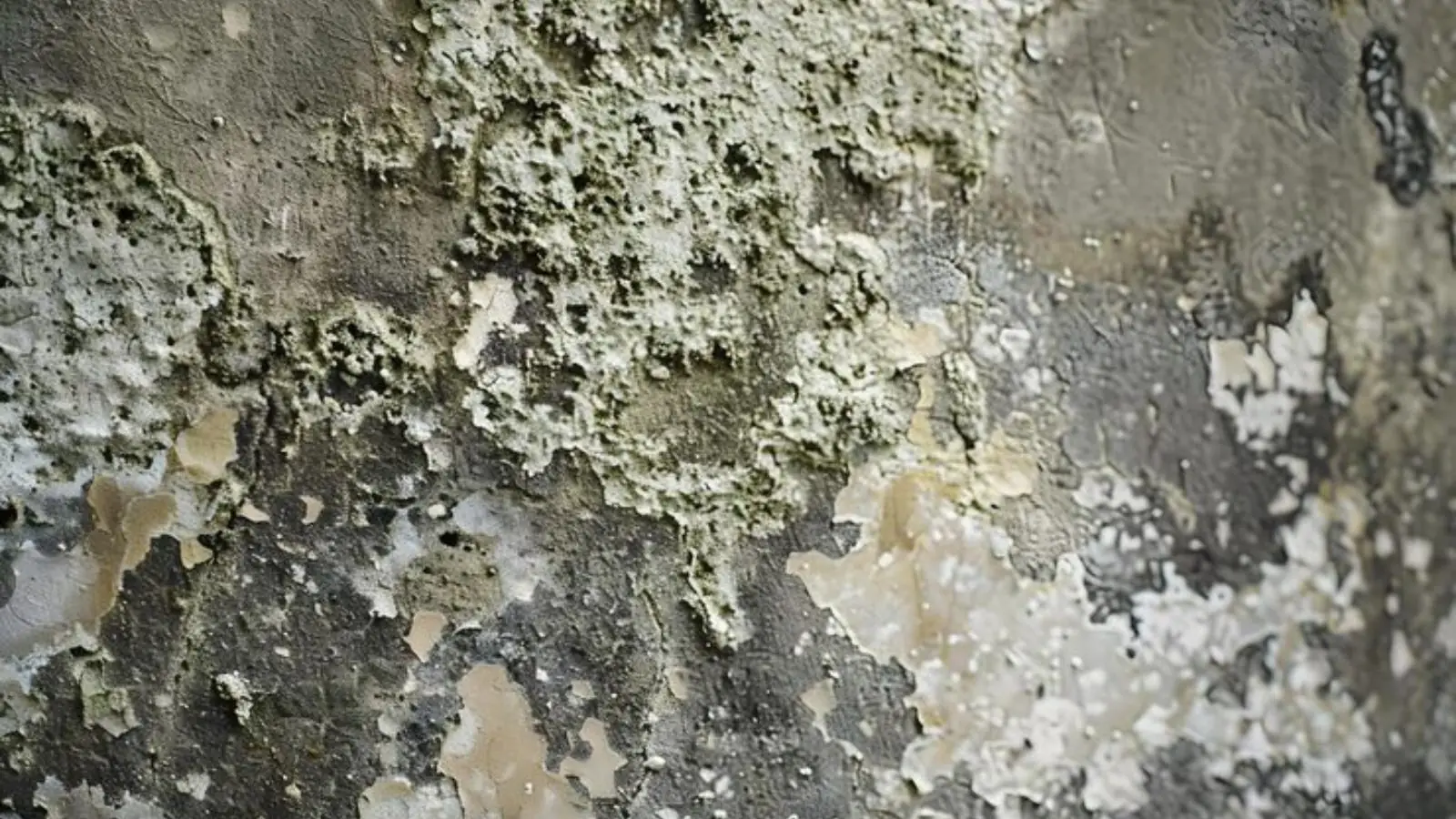
Dark mold on a surface often appears as speckled dots, spreading patches or fuzzy clusters in black, dark green or gray. It tends to show up where moisture lingers: ceiling corners, behind furniture on exterior walls, under sinks and around windows. The look alone is not proof.
Color cannot confirm what species of mold you have, and nothing here is a diagnosis or a statement about health, which is a question for a physician. A lab can identify a type, but EPA says that when visible mold is present, sampling is usually unnecessary. What matters for the cleanup decision is size, material and moisture.
Patterns people usually describe
Speckled dots
Small dark spots in clusters, often starting at a corner or along a seam and spreading outward over time.
Fuzzy or velvety patches
A raised texture on a surface, sometimes with a lighter edge. It can smear or crumble when touched, so avoid touching it.
Dark smears around a stain
Growth that follows the outline of an older water stain, with a brown ring or yellowish halo.
Dark growth on the back side
Wallpaper, carpet backing, the underside of a vanity or the back of drywall can hold growth that never shows on the front.
Smell is another clue people mention. A musty, earthy odor in a room with no visible spot can point to hidden moisture inside a wall, under flooring or above a ceiling. Treat that smell as a reason to look for water, not as a verdict.
How the look changes with the surface
On painted drywall, growth often looks like spots that bleed through the paint, sometimes with a ring where water traveled. On wood, it may follow the grain or collect in cracks. On grout and caulk, it hides in the lines and can leave a stain even after cleaning.
On fabric, carpet backing and ceiling tile, which are porous, the discoloration sits inside the material rather than on top. That difference matters, because EPA treats porous materials that stayed wet as often impossible to clean fully. A stain that has soaked in is a stronger reason to look into removal.
Things that look like mold but are not
| Look-alike | How it appears | How it differs |
|---|---|---|
| Dirt and dust | Gray or black film near vents, corners and light fixtures | Wipes away cleanly and has no moisture source nearby |
| Soap scum and mildew film | Dark film on shower walls, caulk and grout | Surface layer on bathroom surfaces, though persistent dampness still matters |
| Water stain | Tan or brown ring with a defined edge | Marks past water without necessarily showing growth, though growth can be present too |
| Efflorescence | White or gray powdery crust on masonry or concrete | Mineral salts left when water evaporates, not a living growth |
| Ghosting | Dark lines on a ceiling or wall that trace framing | Dust collecting on cooler spots, most visible over studs and joists |
| Soot from candles | Black marks above candles or vents | Spreads from a heat or smoke source, not from dampness |
Tell-tale signs only suggest the answer. If you are unsure, the moisture source is the better thing to investigate.
Found something dark and not sure what it is?
Call (949) 670-0939 and describe where it is and how large it is. The 24/7 line is open, and scope and price are explained before work starts.
How to look at it without making it worse
Check for moisture before anything else
Feel for dampness, look for a recent leak, and check the room above. A dark spot beside an active leak deserves more concern than one on a dry shelf.
Note pattern and location
Is it near a window, under a fixture, along a ceiling edge or on an outside wall? Location often points to the water source.
Photograph it with scale
Put a ruler or tape beside it and shoot from a few angles. Note the date, so you can compare later.
Measure against the 10 square foot line
EPA says a patch under about 10 square feet, roughly 3 ft by 3 ft, can usually be handled by the homeowner. Larger areas call for a professional.
Why color cannot settle it
Mold in many species can look black, green, gray, brown or white depending on the material, age and moisture. Two patches that look identical can be different organisms, and two that look different can be the same. That is why the popular label black mold is unreliable as a way to identify anything.
EPA notes that no federal limits have been set for mold or mold spores, so a lab result has nothing official to be compared against. Surface sampling can help show whether an area was cleaned adequately afterward. It should be done by professionals experienced in designing and interpreting samples.
What to do once you have a decent idea
If it is a small patch on a hard surface and the leak is fixed, EPA describes cleaning with detergent and water and drying completely. Do not paint or caulk over it. If a stain keeps returning after cleaning, the moisture is still there and mold remediation may be the next step.
If the surface is wet or the area is large, water damage cleanup handles removing damaged materials and sanitizing before the rebuild.
Do not touch or sniff it closely
Leave suspected growth undisturbed until you know the size and the cause. If the damp came from sewage or another contaminated source, stay out of the area and call a professional. If water touched an outlet or panel, cut power only if the panel is dry and safe to reach, and call 911 or your utility first.
Attached Homes and Shared Walls in Laguna Niguel
The city's Housing Element puts single-family detached homes at about 55 percent of units and multifamily at about 25 percent. In condos, townhomes and apartments, a dark patch on a shared wall or ceiling may come from the unit next door or above. Photograph it, tell your HOA or property manager promptly and check your CC&Rs for who handles what.
In a detached house, the same patch usually traces to your own roof, plumbing or ventilation. Our Laguna Niguel dispatch also covers Mission Viejo and Aliso Viejo, where attached housing is common too.
Questions about spotting mold
Color does not tell you that. Many molds look dark, and plenty of dark marks are not mold at all. Questions about effects on a person belong with a physician, and the cleanup decision follows size and moisture.
A photo cannot confirm species. It can help a professional judge the size, the material and the likely moisture source, which is what drives the plan.
EPA says sampling is usually unnecessary when mold is visible. It may be useful later to check whether cleaning worked. Professionals experienced in sampling should design and interpret any tests.
Look for moisture first: a damp wall, a leak above, humid closets or a clogged drain line. Hidden dampness is the more useful finding than the smell itself.
It depends on your CC&Rs and where the water came from. Document it, notify your HOA or property manager, and ask them to confirm responsibility in writing before repairs start.