
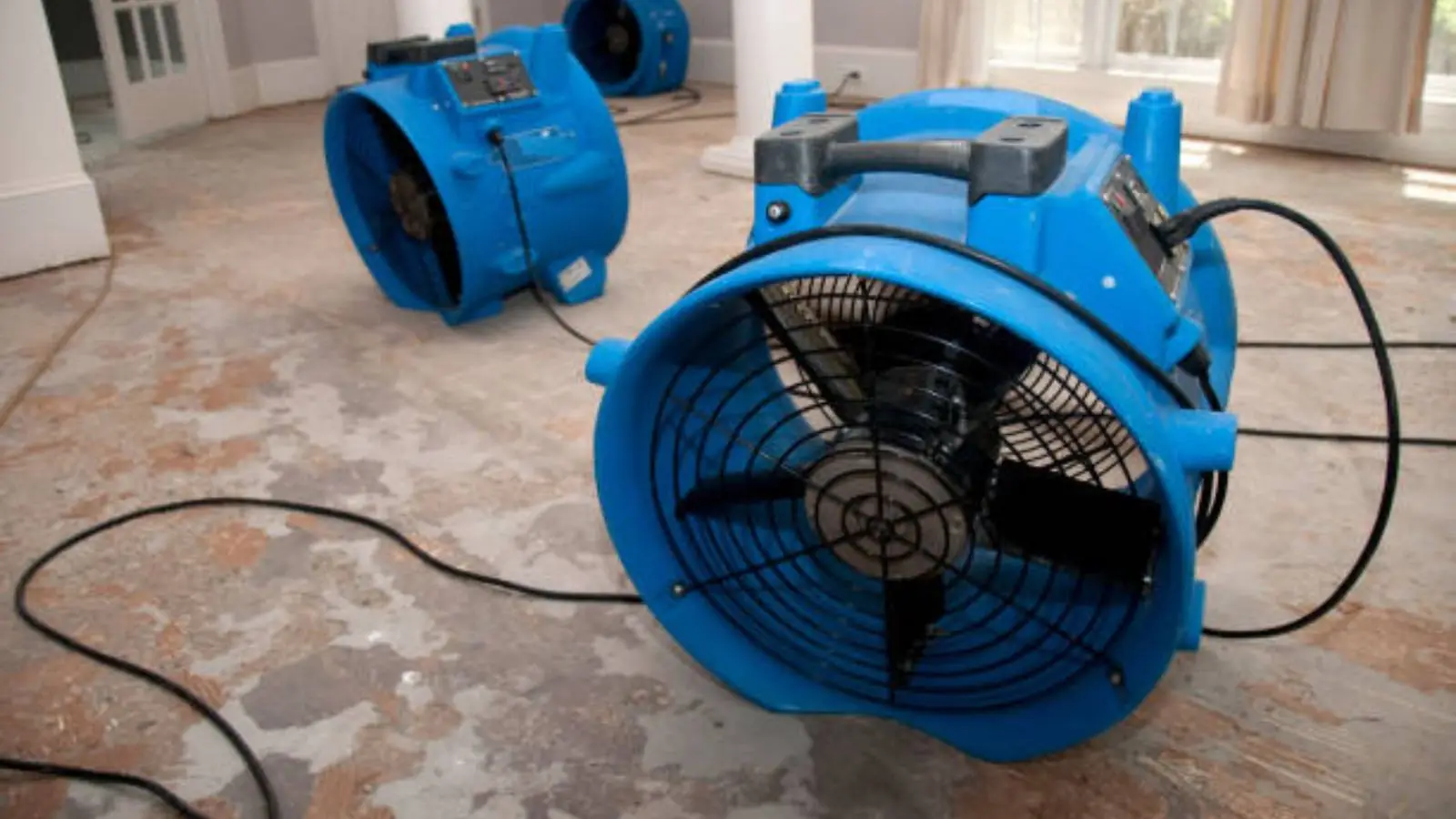
Professional water damage drying means finding every wet surface with meters and a thermal camera, then pulling moisture out with air movers and dehumidifiers until the readings match a dry reference. Crews check those readings every day and remove equipment only when the numbers say the structure is dry. If nobody is measuring, nobody is really drying. They are just running fans.
EPA guidance says to dry water-damaged areas and items within 24 to 48 hours to prevent mold growth. That window is why drying gets planned at the first visit instead of after a few days of waiting. If water is still coming in, water mitigation begins by stopping the source and removing standing water so drying can start.
Step one is a moisture map, not a fan
Wet drywall often looks fine from the middle of the room. Water wicks upward inside walls, travels under flooring and soaks insulation where you cannot see it. A crew reads surfaces with a moisture meter, scans for cooler damp areas with a thermal imaging camera, and probes into cavities where the readings look doubtful.
Those readings are recorded with a time and a location, usually on a simple sketch of the floor plan. The crew also reads an unaffected area of the same material to set the dry goal. Without that reference, there is no honest way to say a wall is finished.
The equipment that does the work
Air movers
High-velocity fans that push air across wet surfaces so moisture leaves the material and enters the air. Placement matters more than count, and units are angled along walls and floors.
LGR dehumidifiers
Low grain refrigerant units pull that airborne moisture out of the room and drain it away. Without them, humid air simply settles back into drywall and framing.
Extraction units
Pumps and wands remove standing water and pull water out of carpet before drying begins. Removing liquid first shortens everything that follows.
Meters and thermal camera
These find the wet material at the start and prove it is dry at the end. They are the difference between a guess and a record you can read.
Crews usually keep doors and windows closed during drying so the dehumidifiers work on a sealed volume of air. That is why you may be asked not to open windows, even on a mild afternoon.
What a drying job looks like day by day
Remove water and ruined materials
Extraction comes first, then removal of anything that cannot be saved, such as soaked carpet pad, wet insulation or drywall that is sagging. ANSI/IICRC S500 defines Category 1, 2 and 3 water, and contaminated materials are removed rather than dried in place.
Set equipment from the map
Air movers go along walls and floors, and dehumidifiers are sized to the space. Crews may lift baseboards or drill small vent holes so air can reach wall cavities.
Check and adjust every visit
Each visit brings new readings. Units get moved, added or shut off as areas reach their goal, so the setup on day three rarely matches day one.
Confirm dry and pull the equipment
Final readings are compared with the dry reference and logged. Only then does the equipment leave and the rebuild conversation begin.
Why some materials dry fast and others do not
| Material | How it behaves when wet | What crews usually do |
|---|---|---|
| Drywall | Absorbs water and wicks it upward | Dry in place if clean and intact, cut out if soaked, sagging or contaminated |
| Carpet pad | Acts like a sponge against the floor | Usually removed and replaced, while the carpet itself may be lifted and dried |
| Hardwood floors | Swells and cups as boards take on water from below | Controlled airflow and drying mats, then reassess for repair |
| Concrete slab | Dense and slow to release moisture | Steady dehumidification with readings tracked until they level off |
| Wall insulation | Holds water and dries poorly | Often removed from wet cavities |
Final decisions depend on the water category, how long materials stayed wet and what the readings show.
Water still spreading through your home?
Call (949) 670-0939. The 24/7 line is open, same-day response is offered when available, and scope and price are explained before work starts.
How long does drying take?
Plan on days, not hours. Clean water in one room on a hard floor can dry quickly, while a soaked slab, thick framing or hardwood takes longer. Nobody can honestly name an exact number before measuring, and a company that does is guessing.
Speed also depends on how fast the water was removed, the water category, the indoor temperature and how much material stayed saturated. The daily readings tell you when the job is done, and the calendar does not. If standing water is still in the house, emergency water removal has to happen before any drying equipment makes sense.
Why we do not rent out air movers and dehumidifiers
Equipment is only half of drying
We do not offer equipment rentals. Drying should be done by trained crews, because the equipment is easy to carry and hard to use well.
A rented fan cannot tell you whether wall cavities are wet, how many dehumidifiers the space needs, or when to stop. Poor placement and no monitoring leave moisture behind, and mold needs moisture to grow.
How to judge a drying company
Ask these before you sign
- Will you map moisture with meters and a thermal camera, and show me the readings?
- What dry goal will you use, and how do you set it?
- Will you log readings at each visit and tell me when equipment changes?
- Do your crews work to ANSI/IICRC S500, the published water damage standard?
- What are you removing instead of drying, and why?
- Is the scope and price explained before work starts?
- Are you licensed and insured?
California's CSLB classification list has no dedicated water damage or drying license. Rebuild trades such as drywall, flooring, painting and plumbing are licensed, and CSLB requires a license for work of $1,000 or more in labor and materials combined. You can check any license with CSLB's License Check tool.
Safety before drying
If water has touched an electrical panel or outlets, or sewage is involved, stay out of the area. Cut power only if the panel is dry and safe to reach, and call 911 or your utility first. For a gas smell, call SoCalGas. Then call the restoration line.
Checking the Water Source in Laguna Niguel Before Drying
Moulton Niguel Water District supplies water in Laguna Niguel. Its troubleshooting guide says the house shut-off valve is typically at the front of your home just below the hose bib. Close it before any drying begins, because drying a house with an active leak never finishes.
The district also describes a meter test. With all water off, movement on the meter means a leak. If the meter stops once you close the house valve, the leak is indoors. If it keeps moving, the problem may be the service line, which calls for a licensed plumber or leak detection. That answer tells you whether a plumber or a drying crew comes first.
After the readings are dry
Once the structure is dry, rebuild decisions start: drywall, paint, flooring and trim. Homes in Aliso Viejo and Dana Point follow the same sequence, with the home base and dispatch in Laguna Niguel.
Ask your insurer how your policy treats sudden and accidental water damage compared with gradual leaks, and photograph everything before materials are removed. Flood is usually excluded from standard homeowners policies and needs separate flood coverage.
Drying questions homeowners ask
Readings on every affected material should match the dry reference taken from an unaffected area. Ask to see the log. Touch and smell are not reliable, because damp framing can feel normal.
Small, clean spills on a hard surface may respond to that. Anything larger leaves wall cavities, pad and subfloor unchecked, and nobody is taking readings. Drying should be done by trained crews for that reason.
EPA says drying wet materials within 24 to 48 hours usually prevents mold growth. Drying fast reduces the risk, but no company can promise a result, so keep watching the area afterward.
Sudden and accidental water damage is often covered, while gradual leaks and neglect often are not. Check your policy and ask your insurer. The real price comes from a scope after assessment.
Turn off all water, read the meter, then close the house shut-off valve. If the meter stops, the leak is on the house side. If it keeps moving, call a licensed plumber or leak detection about the service line.