
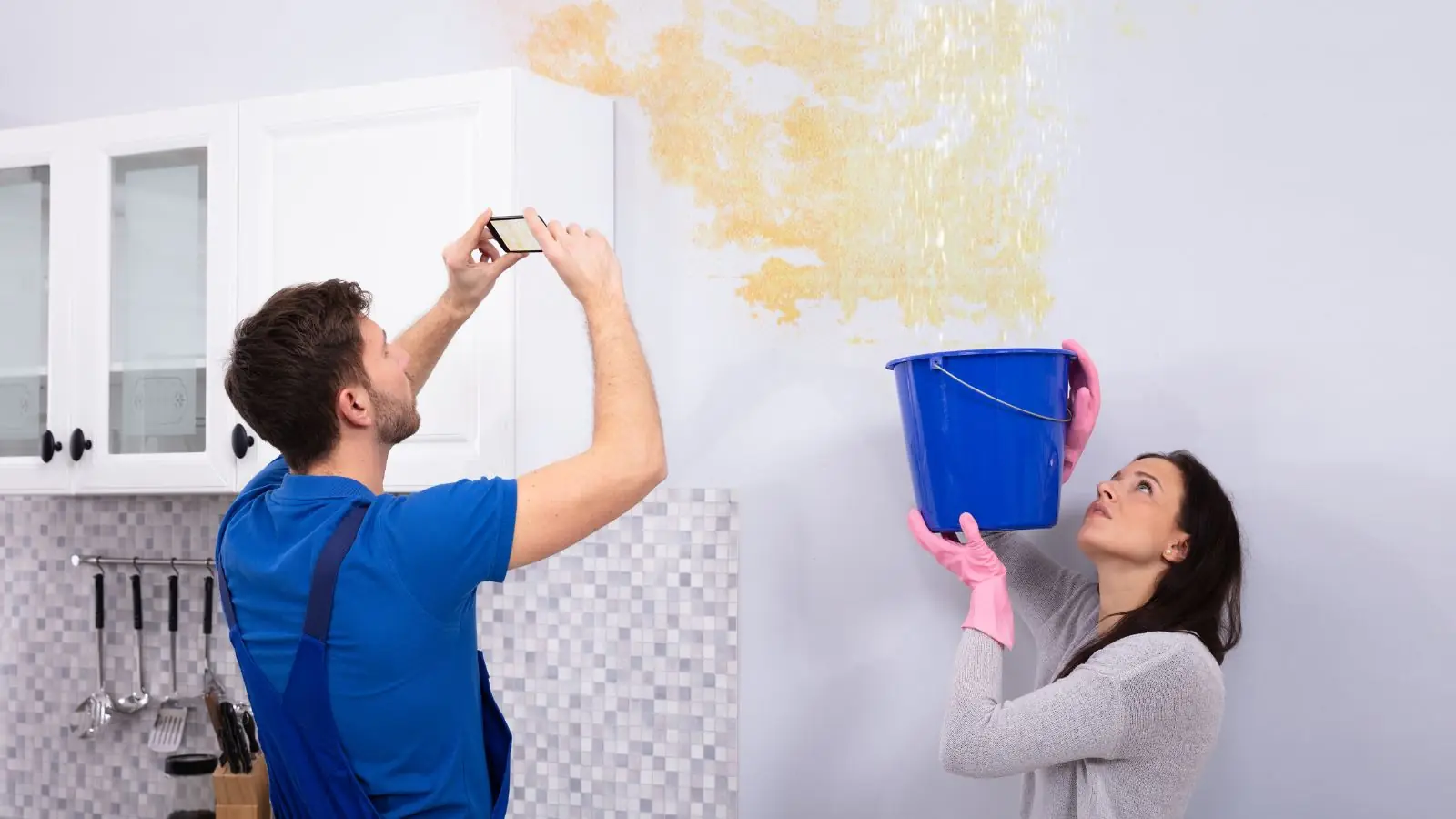
If the leak starts upstairs, you have two jobs at once. One is practical: protect your ceiling and get it dry. The other is administrative: tell your association, document everything, and find out who is responsible for which part of the repair. Responsibility depends on your governing documents and the cause of the leak, so check your CC&Rs and ask your association before you assume anything.
First hour: contain it from your side
You cannot control the pipe in the unit above, but you can control what happens in yours. Do these things before you start making phone calls, as long as the room is safe to enter.
What to do inside your unit
- If water is near light fixtures, outlets or the panel, stay out and call 911 or your electric utility.
- Knock on the door of the unit above, or call the neighbor, so the water supply there can be shut off.
- Place buckets, move furniture and electronics, and lift rugs off the floor.
- Photograph the ceiling, walls, floor and belongings, with timestamps if your phone allows.
- Write down the time you first noticed the leak and who you spoke to.
Four moves that keep a shared-wall leak from turning into a dispute
Notify the association and management
Report the leak in writing the same day, and keep a copy. Many communities have an after-hours number for water emergencies, so check your welcome packet or the association website.
Document before anything changes
Photograph the damage, save texts and emails with the neighbor, and keep receipts for emergency steps. A dated record helps when an insurer or an association manager asks what happened.
Dry the ceiling and walls promptly
A drying crew can extract water and place equipment while the responsibility questions are still being sorted out. EPA guidance says to dry water-damaged areas within 24 to 48 hours to prevent mold growth.
Tell your insurer
Ask how your policy treats damage from a neighbor's unit and what the association's own coverage may handle. Do not assume the answer. Ask your insurer and your association.
Who pays is a document question, not a guess
Condo and townhome communities split responsibility differently. Pipes inside walls, fixtures, interior finishes and the building shell may belong to different parties depending on your governing documents. Check your CC&Rs and ask your association. This article is not legal advice, and a dispute may call for an attorney.
Reputable crews follow the published ANSI/IICRC S500 standard for water damage restoration, and the S520 standard for mold. You can ask any company which standard guides its drying and containment decisions.
Ceiling wet from the unit above?
Call (949) 670-0939, 24/7. We start drying while the paperwork gets sorted, and scope and price are explained before work starts.
Drying a ceiling that you may not be allowed to open
In attached housing, the cavity above your ceiling is usually the floor structure of the neighbor's unit. Opening it may need permission from the association, and the wet area can extend into walls that you share with other units. A crew starts with moisture meters and thermal imaging from your side to map how far the water went.
Then drying equipment goes in. Air movers and LGR dehumidifiers run for days and are checked with a meter at each visit, and your association may want to know about the noise and schedule. Quick drying is the focus of water mitigation work, and removal of soaked materials falls under water damage cleanup.
| Stage | What happens | Who to talk to |
|---|---|---|
| Stop the source | Water supply to the unit above is shut off and the leak is repaired | Neighbor, association, plumber |
| Map and dry | Moisture readings, extraction, air movers and dehumidifiers | Drying crew, association for access |
| Remove damaged finishes | Wet drywall and insulation cut out if drying will not save them | Crew, your insurer |
| Rebuild | Drywall, texture, primer, paint and flooring as needed | Licensed trades, association for approvals |
| Close the claim | Receipts, photos and written scope are submitted | Your insurer, association manager |
Ask your association whether it requires its own approved contractors or notice for work that touches shared walls or floors.
What to ask your association
- Does the master policy cover any part of my ceiling, walls or finishes, and what is the deductible?
- Who is responsible for the plumbing inside the wall and for the fixture that failed?
- Do I need written approval before a crew opens a ceiling, and are there work-hour rules?
- Is there a required notice or form for water damage reports?
- Who is the contact for the neighbor's unit if I cannot reach them?
Sudden and accidental water damage is often covered, while gradual leaks and neglect often are not. Ask your insurer how a leak from a neighbor's unit is handled under your policy, because unit-owner policies and association policies work differently. We cannot promise approval or a payout.
Attached housing in Laguna Niguel
The city's 2021 to 2029 housing element counts about 25,360 housing units, with single-family detached homes making up about 55 percent and multifamily about 25 percent. Most units were built before 1990. The city documents several planned communities, and its environmental documents mention townhome neighborhoods such as El Niguel Terrace.
The city does not publish what share of homes sit in an association, so do not assume yours does or does not. Look at your closing documents to see whether your building is governed by CC&Rs and who manages it. That tells you who to call first when water arrives from above, and it is the first step in any repair plan.
If you live in an attached community in Aliso Viejo or Laguna Hills, the same sequence applies, and our dispatch also covers both.
Condo leak questions
It depends on the cause and on your governing documents. Check your CC&Rs and ask your association, and ask your insurer how your policy responds. A dispute over responsibility is a legal question, so consider an attorney if one arises.
Drying should not wait. Moisture left in place is the thing that grows into a larger and more expensive problem. Document the damage, notify the association and insurer, and start drying.
Contact the association or property manager right away, because they may have an emergency contact or access procedure. If water is spreading and nobody responds, call your association's emergency line. If there is a danger to people, call 911.
Ask your insurer. Many policies have notice requirements, and you may want your own record in case repairs cost more than expected. Keep photos, receipts and messages from the neighbor.
The city's housing element puts multifamily homes at about 25 percent of units and notes that most were built before 1990. The city does not say how many are in associations, so check your own documents. Older buildings may have older supply lines and drain connections, which is one reason to ask the association about its maintenance history.