
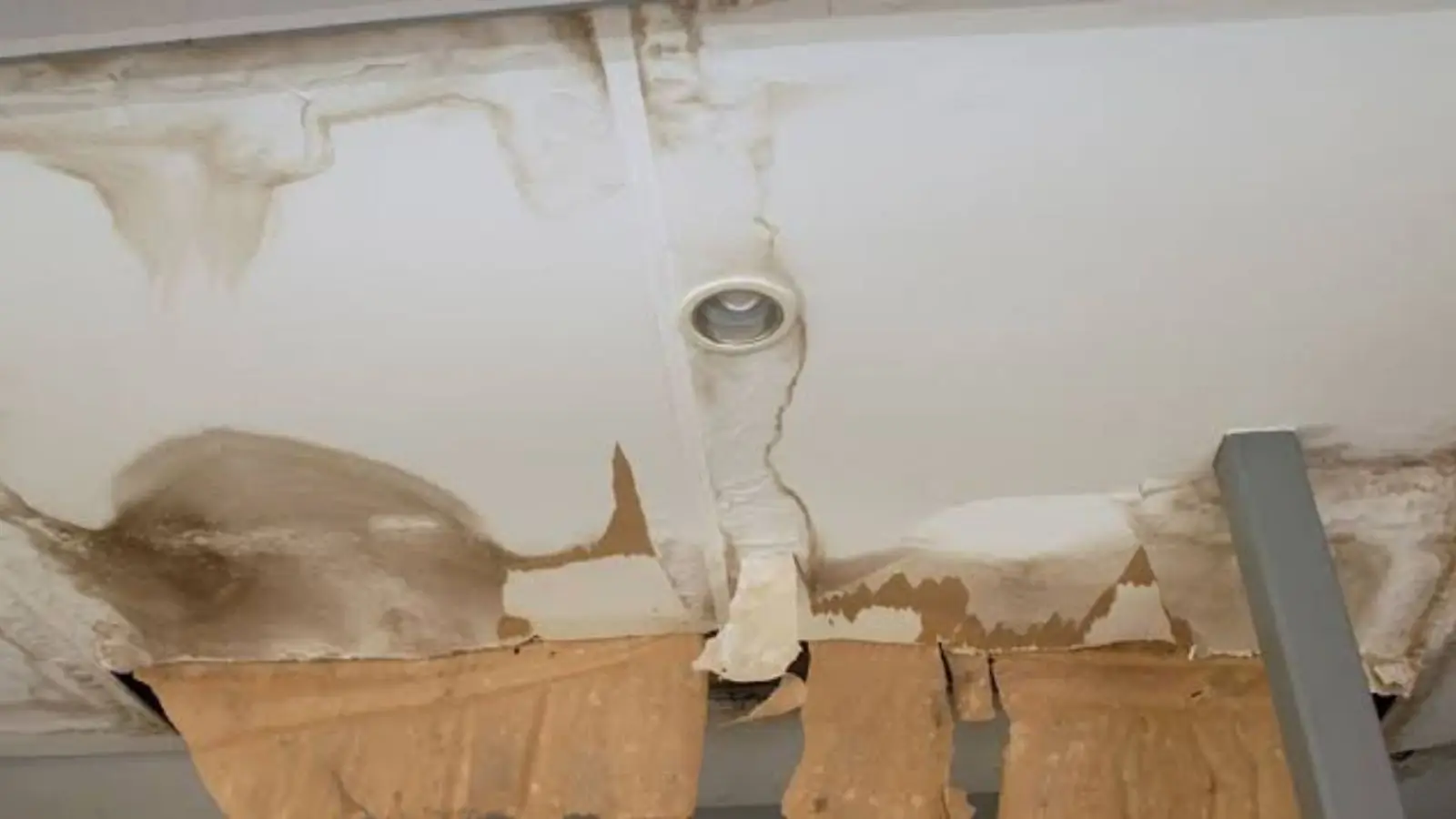
Ceiling repair only holds once the water has stopped. Patching a stain while a supply line still weeps just repaints the same problem a few weeks later. The sequence that works is to find and stop the source, dry everything wet, cut out what is ruined, then patch, prime and paint. A dry, dinner-plate-sized stain is often a weekend job, while a sagging or wet ceiling needs moisture readings first.
Make the room safe before you pick up a tool
Water and ceiling light fixtures are a bad mix. If water is dripping through a fixture or fan, stay out of the room. Cut power only if the panel is dry and safe to reach, and call 911 or your electric utility before you call anyone else.
Do this before any repair work
- Switch off the circuit for the room only from a dry panel, never while standing in water.
- Put a bucket under the drip and move furniture, rugs and electronics out of the drip zone.
- If the ceiling bulges with trapped water, stand to the side and puncture the lowest point over a bucket so it drains in a controlled way.
- Photograph the stain, the room above and any wet contents before you move or clean anything.
- Keep children and pets out of the room until the ceiling has stopped dripping.
Four stages from wet ceiling to fresh paint
Each stage below has to be finished before the next one starts. Skipping ahead is the most common reason a repaired ceiling stains again. Moving through them in order takes a few days for a small area, mostly because of drying time.
Find and stop the source
Check the room above first: toilet and sink supply lines, a tub overflow, a washer box, an air conditioner condensate line. If nothing upstairs is wet, look at the roof and flashing after rain. Close the fixture's angle stop or the house shut-off, and do not move on until a dry paper towel pressed on the stain stays dry.
Dry the cavity, not just the surface
Paint dries in an hour, but insulation and framing above the ceiling stay wet for days. Open a small inspection hole, pull out soaked insulation, and run air movers until a moisture meter reads close to a dry reference wall. EPA guidance says to dry water-damaged areas within 24 to 48 hours to prevent mold growth.
Cut out and replace the damaged drywall
Mark a square or rectangle that extends past the stain to solid framing, cut it with a drywall saw, and check the cavity behind it. Screw a new piece to the joists or to added backing strips, then tape the seams and apply joint compound in thin coats, sanding between each one.
Seal, prime and paint
Brush a stain-blocking primer over the patch and a few inches beyond it. Match the ceiling texture before painting, then paint the whole ceiling plane edge to edge. Painting only the patch usually leaves a visible halo.
Stage two is where most do-it-yourself repairs go wrong. A ceiling can feel dry while the insulation above it holds water, and that trapped moisture feeds mold and re-stains the new paint. Rented fans without a moisture meter only guess at when the job is finished.
Not sure how wet the ceiling really is?
Call (949) 670-0939, 24/7. Same-day response when available, with scope and price explained before work starts.
DIY or crew: how to read your ceiling
| What you see | What it usually means | Next move |
|---|---|---|
| Dry stain smaller than a dinner plate, no sag | Old or one-time leak that has stopped | Confirm it is dry, then prime and paint |
| Stain that grows or darkens after showers or rain | Active leak above the ceiling | Find the source before any patching |
| Soft, sagging or bubbling drywall | Saturated board and probably wet insulation | Drain it safely, cut out, dry the cavity |
| Stain wider than a few feet or across two rooms | Larger release of water through the framing | Call a crew for moisture mapping and drying |
| Brown water, odor or sewage source | Contaminated water, ANSI/IICRC S500 Category 2 or 3 | Stay out and call a professional crew |
ANSI/IICRC S500 is the published industry standard that defines water Category 1, 2 and 3. Ask any company whether its crews work to it.
What you can handle and what to hand off
A confident homeowner can usually patch a hole smaller than a square foot after the area is verified dry. That means cutting, taping, mudding, priming and painting with ordinary hand tools. Texture matching takes practice, so expect to try it on scrap board first.
Hand the job off when drywall is sagging across a large area, when the source is hidden, or when wet insulation is likely. The same goes for any ceiling that has stayed damp for more than two days. A crew running water mitigation can map moisture in the cavity before anyone cuts a hole, and the rebuild afterward falls under water damage repair.
Moisture meter
Reads wetness inside drywall and framing so you know when drying is done, not just guessed.
Drywall saw and utility knife
For clean cut-outs that land on framing so the new piece has something to fasten to.
Stain-blocking primer
Seals tannin and rust marks so they do not bleed through the finish coat.
Joint compound and tape
Three thin coats feather better than one thick coat, and each coat needs to dry fully.
Tracing the leak in a Laguna Niguel house
Moulton Niguel Water District, which supplies water in Laguna Niguel, says the house shut-off valve is typically at the front of the home just below the hose bib. Its leak test is simple: turn off every fixture, check the meter, then close the house valve. If the meter keeps moving with the valve closed, the leak is outside the house plumbing, so call a licensed plumber or leak detection company before you open any ceiling.
That one test saves you from cutting into a ceiling that was never the problem. If the meter stops when the valve closes, the leak is indoors and your search narrows to the room above. The city is dry for much of the year and wet from roughly November to March, so a stain that appears only after winter storms points to the roof rather than a pipe.
When a ceiling stain means a mold question
Mold needs moisture, so a ceiling that stayed wet past the 24 to 48 hour window deserves a closer look. EPA says an area under about 10 square feet can usually be handled by a homeowner, and that painting over mold does not fix it. Larger growth, or mold plus a lot of water damage, calls for professional help under mold remediation practice, which follows the ANSI/IICRC S520 standard.
Health questions about mold belong to your physician. Do not use paint color or smell to guess what is growing above your ceiling.
Neighbors nearby, same ceiling problem
Ceiling leaks follow the same pattern across south Orange County. Our dispatch also covers Aliso Viejo, where many homes are condos and townhomes, and Laguna Hills, just north of Laguna Niguel. The four-stage method above applies in all three.
Ceiling repair questions
Only after you have confirmed the area is dry and the source is fixed. Use a stain-blocking primer first, because ordinary paint lets brown marks bleed back through. If the drywall is soft or the stain keeps returning, paint will only hide a problem that is still active.
Small, surface-level wetting can dry in a day or two with moving air. Wet insulation and framing take longer, which is why moisture readings matter more than the calendar. EPA guidance aims for drying within 24 to 48 hours to prevent mold.
Usually not. Damaged drywall is cut out in a clean square or rectangle that reaches solid framing, and the rest of the ceiling stays. Texture and paint are then blended across the full ceiling plane so the repair does not show.
Sudden and accidental water damage is often covered, while gradual leaks and neglect often are not. Read your policy or ask your insurer before permanent repairs, and photograph everything first. Flood is usually excluded from standard homeowners policies.
The city's Building and Safety Division handles permits, and its pages do not spell out rules for water damage repairs. A small drywall patch is unlikely to be the question, but plumbing, electrical or structural work might be. Call the division at City Hall before you start if you are unsure.